Workplace wellbeing.
What a session can change, and what it cannot.
Most workplace wellbeing programmes mix two very different things: problems that come from how the work is organised, and states that live in the body. The first kind is not fixed by anything you can book. The second kind can shift within an hour, and there is decent evidence for it. Knowing which one you are dealing with is the whole decision, and almost nobody selling wellbeing will tell you.
What does workplace wellbeing actually mean?
In practice the term covers everything an organisation does so that people are not worn down by their work: workload, autonomy, management, physical conditions, and increasingly collective practices such as breathing, movement or meditation.
The trouble is that the word is used for both the cause and the remedy. A company can say it is working on wellbeing while running a fruit basket and a yoga class on top of an unchanged workload. The honest version starts by separating the two.
Three columns, not one list
Sort what you are looking at into three columns before you book anything. The third column is where a collective practice belongs, and it is much narrower than most providers admit.
| What it is | Where it comes from | What actually helps |
|---|---|---|
| Workload, deadlines, understaffing | How work is organised | Nothing you can book. Only a decision about the work itself |
| Unclear roles, no autonomy, poor management | Structure and management | Organisational work, training, sometimes mediation |
| Physical conditions: noise, light, no quiet space | The building | Fixes to the space |
| Accumulated arousal: a body that stays switched on | Physiology | A collective practice can shift this, within the hour |
| Isolation between colleagues | Social fabric | Shared experiences, including team practices |
What a collective breathing practice can change
This is the one column where we can speak from both practice and published evidence, and we will stay inside it.
A 2023 meta-analysis of randomised controlled trials found that breathwork was associated with lower self-reported stress compared with control conditions: Fincham et al., Scientific Reports, 2023. A 2023 controlled study found that brief daily structured breathing practices improved mood and reduced physiological arousal, with the strongest effect for a slow exhale-focused pattern: Balban et al., Cell Reports Medicine, 2023.
Two things matter about those studies. They are about breathing practices, not about corporate wellbeing programmes: no study here says that booking a session improves a company. And they measure a change of state, within the hour or over a few weeks of daily practice, not a change in anyone's working conditions.
What it cannot do, and why we say so
If people are exhausted because there is too much work for too few people, a session will feel good on the day and change nothing on the Monday. Worse, it can become the proof that something was done, which makes the real conversation easier to avoid.
We say this before a corporate booking rather than after. If the brief is really about workload or management, a practice is not the answer, and selling it as one would be dishonest. If the brief is about a team that is permanently switched on, that never lands, that has not shared anything outside of meetings in a year, then it is the right tool.
What a session looks like with a team
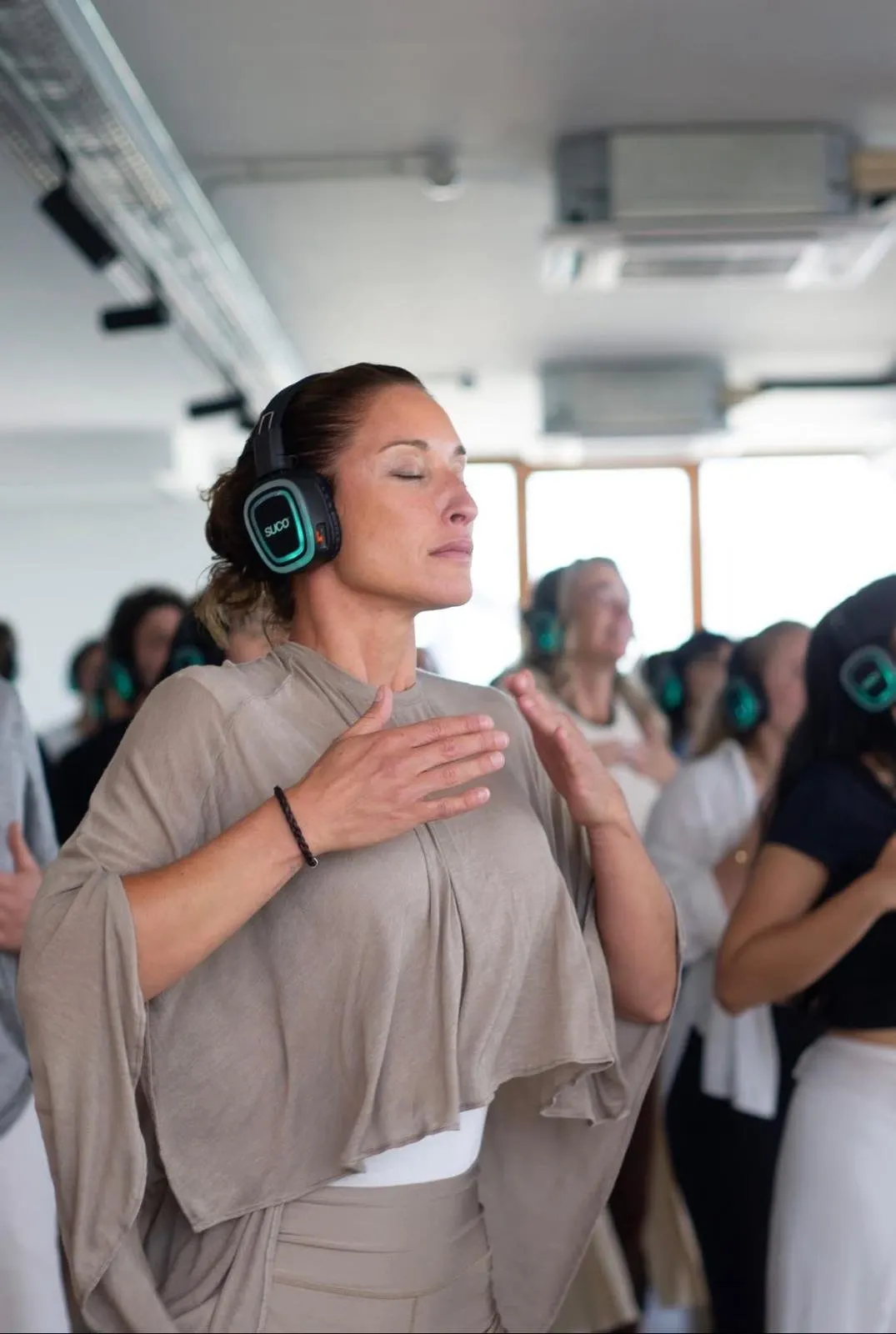
At EMME it is a guided practice, with wireless headphones so that the group moves together while each person stays inside their own experience. One theme per session, from activation to stillness. No steps to learn, no performance in front of colleagues, which matters for the quieter half of any team.
Nobody is asked to share anything afterwards. That single rule is what makes it workable in a professional setting: people can have a real experience without owing their colleagues an account of it.
The full format for organisations is on our team building page, and the practice itself is described on the SUCO page.
Frequently asked questions
Does workplace wellbeing actually reduce stress?
It depends entirely on what is causing the stress. For stress that comes from workload, understaffing or management, no activity fixes it. For accumulated physiological arousal, a body that stays switched on, there is published evidence that structured breathing practices reduce self-reported stress and physiological arousal. The two are often mixed together, which is why wellbeing programmes get a bad reputation.
What is the difference between workplace wellbeing and team building?
Team building is usually about the relationships inside a group. Wellbeing is about the state people are in. They overlap when a shared practice does both, but they answer different briefs. A team that works well together and is exhausted does not need more bonding.
Can a single session change anything?
It can change a state, and that is measurable within the hour. It does not change working conditions, and we do not claim it does. Teams that get the most out of it are usually the ones where the organisational side is already being handled separately.
Who tends to be left out by wellbeing activities?
The people who do not want to perform in front of colleagues. Any format that requires speaking, improvising or being watched quietly excludes them, and they are often the ones who would benefit most. Practices done in headphones, with no sharing afterwards, avoid that.
Do you need to be fit or flexible to take part?
No. There is nothing to learn and nothing athletic about it. People take part sitting, standing or lying down. Anyone with a specific medical condition should check with their doctor first, as with any new practice.
Can this be done in our offices?
Yes, if there is a room where people can move a little and not be interrupted. The headphones solve most of the acoustic problem, which is usually the limiting factor in an office.
Sources
- Fincham G. W., Strauss C., Montero-Marin J. & Cavanagh K. (2023). Effect of breathwork on stress and mental health: a meta-analysis of randomised-controlled trials. Scientific Reports, 13:432.
- Balban M. Y. et al. (2023). Brief structured respiration practices enhance mood and reduce physiological arousal. Cell Reports Medicine, 4(1):100895.
Rather live it than read about it?
Write to us on WhatsApp, +34 687 950 352: we tell you the next session in Gavà Mar, Castelldefels or Sitges.
Keep reading
Team building activities. What each one builds, and what it asks of your team.
Team building activities sorted by what they ask of a group: what each family builds, who it quietly excludes, and when more energy backfires on a team.
What is rebirthing? Origins, a real session, and the cautions.
Rebirthing breathwork: where it comes from, what a session involves, why it is not the restraint practice of the same name, and who should avoid it.
What is breathwork? Types, benefits and how to start.
What breathwork is, its main types (holotropic, rebirthing, Wim Hof, SOMA, pranayama), what science says about its benefits and how to start safely.
Holotropic breathwork: what it is, a session, the risks.
Created by Stanislav and Christina Grof, it combines fast breathing and evocative music. How a session works, its risks and gentler alternatives.
The Wim Hof method: breathing, benefits and contraindications.
How Wim Hof breathing is done step by step, what science says about its effects and who should not practise it, with the basic safety rules.
Breathing exercises for anxiety: five guided practices.
Five guided breathing exercises, each with a free timer, to calm anxiety within minutes and sleep better. What the science says, and when to ask for help.
What is a spiritual retreat? What really happens, hour by hour.
A spiritual retreat is a few days away from your routine, with a daily practice and a group. What a day really looks like, and who it does not suit.
How to choose a breathwork retreat. Seven questions, and the answers to expect.
Choosing a breathwork retreat: who facilitates, whether anyone screens you before booking, which techniques you will actually do, and how big the group is.
Ecstatic dance: what it is and how it differs from SUCO.
Ecstatic dance and SUCO both get you moving without steps to learn. One is free dance to a DJ set, the other a guided meditation in headphones. Which suits you?
How to choose a spiritual retreat near Barcelona.
Silent, yoga, breathwork or therapeutic: how to choose a spiritual retreat near Barcelona, which questions to ask the organiser and which red flags to avoid.
Is breathwork dangerous? Risks, precautions and benefits.
Slow breathwork is low risk for most people. Fast breathing and breath-holds are another story: what happens in the body, who should avoid it, how to stay safe.
Types of meditation: which one suits you, and where in Barcelona.
Seated, guided, active or breath-based: the main types of meditation for beginners, which one suits you, how to try it free and where in Barcelona.