How to choose a breathwork retreat.
Seven questions, and the answers to expect.
A breathwork retreat is a short stay where the breathing practice is the centre of the programme, not an extra on a timetable. What separates a good one from a risky one is rarely the photography: it is who facilitates, whether anyone asks about your health before taking your money, which techniques are actually on the programme, and how many people are in the room. Ask those four things and most of the choice is already made.
What makes a breathwork retreat different from a wellness retreat?
On a wellness retreat, breathing is usually one activity among many: a class before breakfast, a workshop on the third afternoon. On a breathwork retreat, the practice is the spine of the week. Everything else, the food, the walks, the free hours, exists to let the sessions land.
That difference matters because breathwork is not a gentle add-on. Intense, fast techniques move a lot: tears, shaking, strong emotion, tingling hands. There is published evidence that structured breathing practices reduce stress and improve mood, including a 2023 meta-analysis of randomised controlled trials and a systematic review of slow breathing, and that is exactly why a retreat built around them needs a frame, not just a nice location.
So the first question to ask about any retreat is simple: how many breathwork sessions are there, and who decides when they happen?
Who is facilitating, and what are they trained in?
This is the question that filters the market fastest, and a straight answer is easy to give. Ask what training the facilitators completed, with which school or lineage, and how often they guide groups outside retreats.
The last part matters more than it looks. Someone who facilitates weekly, all year, has seen hundreds of reactions and knows what to do with an unexpected one. Someone who runs two retreats a year has not. Weekly practice is where the reflexes are built.
Ask also who is in the room during a session. On an intense technique, one facilitator for a large group cannot watch everyone. A good answer sounds like a number, not like reassurance.
Is anyone screening you before you take the booking?
This is the clearest signal of all, and the easiest to check. A retreat that takes your card without a single health question has decided that filling places matters more than who fills them.
Intense breathwork is not recommended without medical advice during pregnancy, or with cardiovascular disease, high blood pressure, severe asthma, epilepsy or a severe psychiatric condition. Our own guide, is breathwork dangerous, goes through those cases in detail, and the frequently asked questions page lists them plainly.
At EMME, booking a place on the desert retreat starts with a call rather than a payment link, for this reason. It is also the moment to say if you are in a difficult period: an intensive week is not the right container during an acute psychiatric episode, a recent withdrawal or the first weeks of grief.
Which techniques will you actually practise?
Breathwork is a family of practices that do very different things, and a programme that only says breathwork is telling you nothing. Ask which techniques, and what each is for.
| Family | What it does | What it asks of you |
|---|---|---|
| Slow, regulating breathing | Lowers nervous system activation, settles the body | Very little: it suits almost everyone |
| Dynamic, activating breathing | Switches the body on, sharpens clarity | Effort, and a clear medical go-ahead if you have a condition |
| Emotional release work | Opens what has been held in and lets it move | Willingness to feel, and a facilitator who stays present |
| Holotropic style, long sessions | Deep, long, often with music in the dark | The most demanding of the four: experience in the room is not optional |
What is the music doing?
On a retreat built around breath and movement, music is not background. It carries the arc of a session: when the body activates, how long it stays there, when it comes down. A playlist assembled the night before does a different job from a score written for the group in front of you.
It is worth asking who chooses it, and whether it changes from one day to the next. On the EMME desert retreat, Emmanuel composes the music for each session, and the morning Active Meditation happens in wireless headphones, so the group moves together while each person stays inside their own experience.
Headphones are not a gadget either. They remove the feeling of being watched, which is precisely what stops most people from letting go.
How big is the group, and why does it matter?
Small is not a marketing adjective here, it is a safety parameter and a social one. In a group of forty, a facilitator cannot see who has stopped breathing well, and you will not know most of the people you came to be vulnerable in front of.
Ask for the maximum, not the average. A retreat that answers around twenty to thirty has no maximum. Ours is capped at twelve participants, which is also what makes arriving alone easy: twelve people cannot form a closed circle of friends.
Ask what happens if fewer people sign up, too. A retreat that runs with four is a different experience from the one you were sold, and it is fair to know in advance whether it still goes ahead.
Does the place do any of the work?
Mostly, no. A beautiful location is not a method, and plenty of transformative work happens in a room with a wooden floor. What a place can do is remove interference: noise, screens, errands, the pull of the life you left on Tuesday.
That is the honest case for a remote setting. Looking for a breathwork retreat in Europe gives you plenty of choices within two hours of a plane, from Andalusian farmhouses to Alpine chalets, and a meditation retreat in Europe will often be cheaper to reach than a long-haul one. What a desert adds is the absence of almost everything: no traffic, no neighbours, no signal to speak of. The silence is not an aesthetic, it is a working condition.
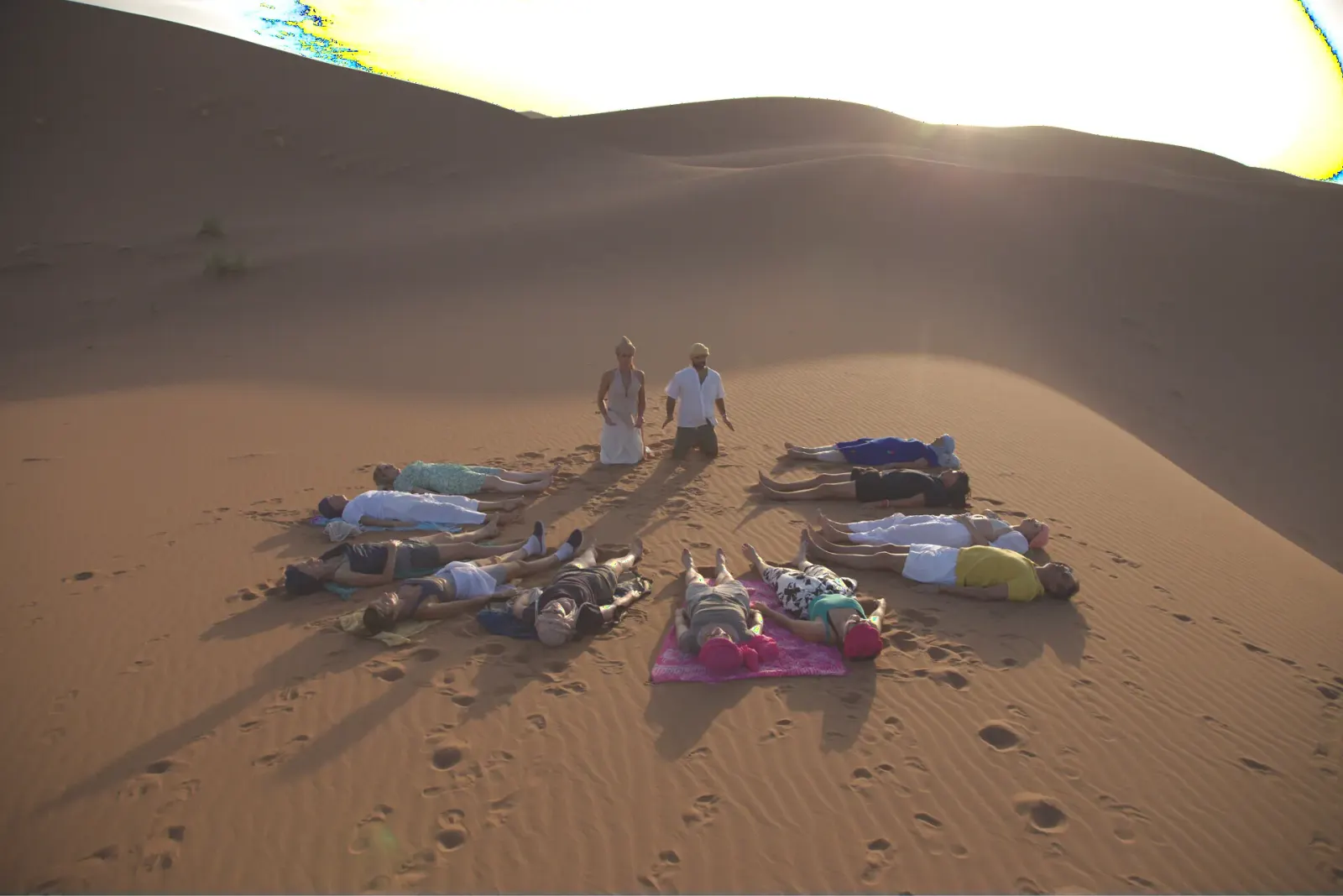
Our own breathwork desert retreat runs from 20 to 27 February 2027 in Merzouga, beside the Erg Chebbi dunes, seven nights at the same camp, with a direct flight from Barcelona. February gives around 21 °C by day and 5 °C at night, which is the kind of detail worth asking any organiser: a place that holds you in the day can be hard at four in the morning.
Seven questions to ask before you pay
Send these in one message. How an organiser answers tells you as much as what they answer.
How we put this together
These are the questions we are asked most often before a retreat, and the ones we think should be asked more. The criteria come from facilitating these practices weekly, year round, and from running groups in the desert rather than from a survey.
The two studies linked above are about breathing practices in general, not about retreats: there is no published evidence that a retreat format produces better outcomes than a weekly practice, and we are not claiming it does. Breathwork is a practice of self-regulation, movement and connection. It is not a therapy and it does not replace medical or psychological treatment.
Frequently asked questions
What is a breathwork retreat?
A short stay, usually between a weekend and a week, where breathing practice is the centre of the programme rather than one activity among many. Sessions repeat daily, and the hours in between are part of the method: they are when what happened in a session settles.
How do I know if a breathwork retreat is safe?
Look at what happens before you pay. A retreat that asks about your health, lists contraindications openly and talks to you before confirming a place has a screening process. One that takes a card with no questions does not.
Who should not do an intense breathwork retreat?
Intense techniques are not recommended without medical advice during pregnancy, or with cardiovascular disease, high blood pressure, severe asthma, epilepsy or a severe psychiatric condition. An intensive week is also the wrong container during an acute psychiatric episode, a recent withdrawal or the first weeks of grief.
How many people should there be on a breathwork retreat?
Ask for the maximum rather than the average. Small groups let facilitators actually watch the room during intense sessions, and they make arriving on your own much easier. Our desert retreat is capped at twelve.
Do I need experience to join a breathwork retreat?
No. Every step is guided, and you can slow down, rest or simply watch at any moment. What matters more than experience is that the facilitators know what to do when something strong moves.
Is a breathwork retreat in Europe better than a long-haul one?
Not better, easier to reach and usually cheaper to get to. The question is what interference the place removes. A remote setting with no traffic, no errands and almost no signal does work that a venue an hour from a city cannot.
What happens after a breathwork retreat?
The week back is the part most programmes say least about, so ask. What you are looking for is a practice you can keep doing alone, and someone to write to if something surfaces later.
Can I go to a breathwork retreat alone?
Yes, and most people do. In a small group it is straightforward: nobody is joining an existing circle of friends, because there is not one.
Sources
- Fincham G. W., Strauss C., Montero-Marin J. & Cavanagh K. (2023). Effect of breathwork on stress and mental health: a meta-analysis of randomised-controlled trials. Scientific Reports, 13:432.
- Zaccaro A. et al. (2018). How breath-control can change your life: a systematic review on psycho-physiological correlates of slow breathing. Frontiers in Human Neuroscience, 12:353.
Rather live it than read about it?
Write to us on WhatsApp, +34 687 950 352: we tell you the next session in Gavà Mar, Castelldefels or Sitges.
Keep reading
Workplace wellbeing. What a session can change, and what it cannot.
Workplace wellbeing sorted honestly: what belongs to how work is organised, what a collective practice can actually change in an hour, and where the line sits.
Team building activities. What each one builds, and what it asks of your team.
Team building activities sorted by what they ask of a group: what each family builds, who it quietly excludes, and when more energy backfires on a team.
What is rebirthing? Origins, a real session, and the cautions.
Rebirthing breathwork: where it comes from, what a session involves, why it is not the restraint practice of the same name, and who should avoid it.
What is breathwork? Types, benefits and how to start.
What breathwork is, its main types (holotropic, rebirthing, Wim Hof, SOMA, pranayama), what science says about its benefits and how to start safely.
Holotropic breathwork: what it is, a session, the risks.
Created by Stanislav and Christina Grof, it combines fast breathing and evocative music. How a session works, its risks and gentler alternatives.
The Wim Hof method: breathing, benefits and contraindications.
How Wim Hof breathing is done step by step, what science says about its effects and who should not practise it, with the basic safety rules.
Breathing exercises for anxiety: five guided practices.
Five guided breathing exercises, each with a free timer, to calm anxiety within minutes and sleep better. What the science says, and when to ask for help.
What is a spiritual retreat? What really happens, hour by hour.
A spiritual retreat is a few days away from your routine, with a daily practice and a group. What a day really looks like, and who it does not suit.
Ecstatic dance: what it is and how it differs from SUCO.
Ecstatic dance and SUCO both get you moving without steps to learn. One is free dance to a DJ set, the other a guided meditation in headphones. Which suits you?
How to choose a spiritual retreat near Barcelona.
Silent, yoga, breathwork or therapeutic: how to choose a spiritual retreat near Barcelona, which questions to ask the organiser and which red flags to avoid.
Is breathwork dangerous? Risks, precautions and benefits.
Slow breathwork is low risk for most people. Fast breathing and breath-holds are another story: what happens in the body, who should avoid it, how to stay safe.
Types of meditation: which one suits you, and where in Barcelona.
Seated, guided, active or breath-based: the main types of meditation for beginners, which one suits you, how to try it free and where in Barcelona.