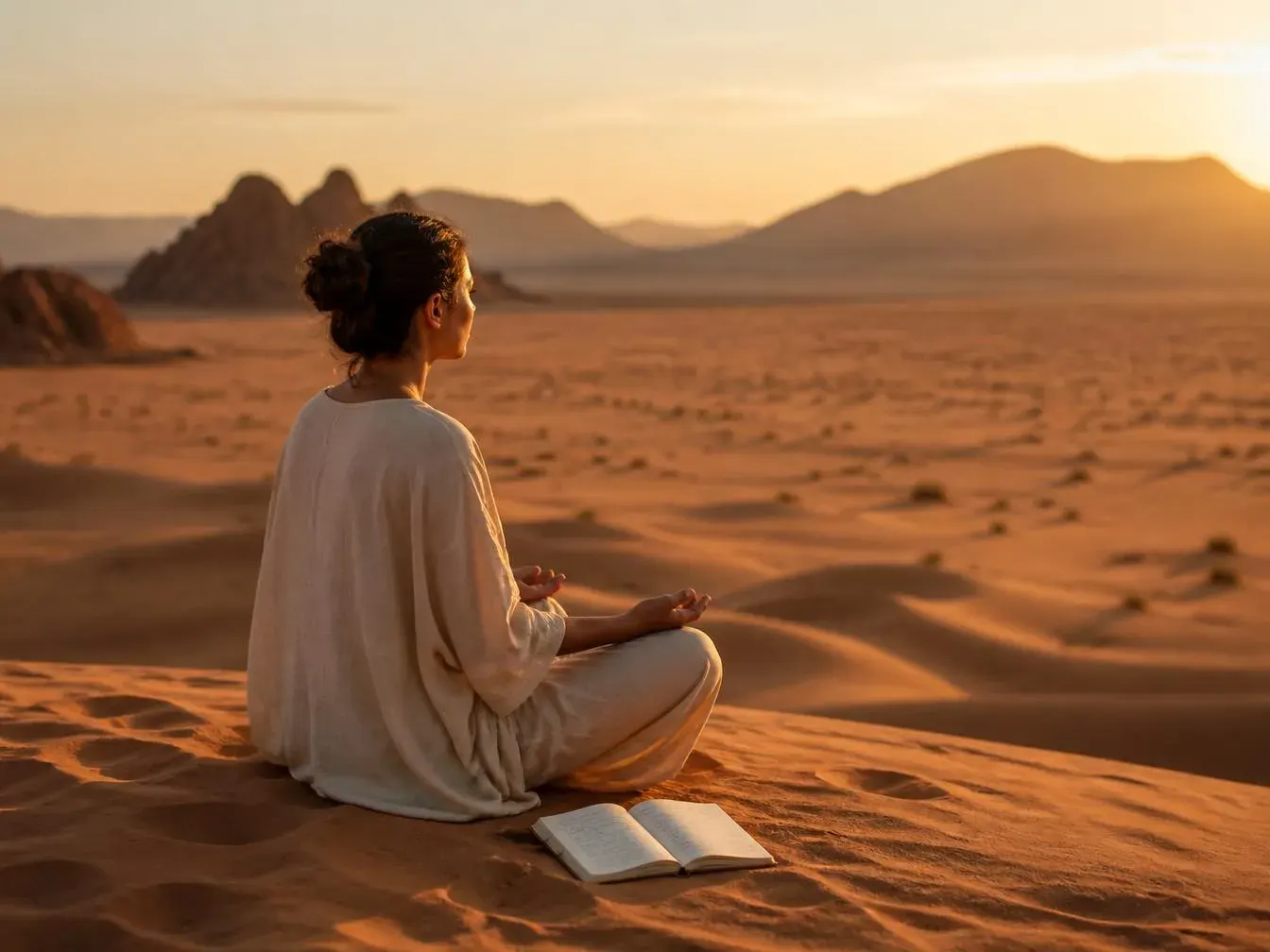
What is a spiritual retreat?
What really happens, hour by hour.
A spiritual retreat is a short stay away from your routine, built around a daily practice and a small group. It does not have to be religious: most retreats today are secular, and the word spiritual points to attention and inner life rather than to a faith. What changes you is rarely the location. It is the repetition of the same practice, several times a day, with nothing else to do.
What actually happens during a day?
This is the part the photos never show. Most retreats run on a rhythm that repeats, and the repetition is the method.
A typical day opens early with a sitting or a breathing practice, before the mind has filled up. The main session comes in the morning, when attention is highest: that is where the deeper work happens. The middle of the day is quiet, often deliberately empty. A second, softer session follows in the late afternoon, and the evening closes with something that settles the group, music, sharing or silence.
The empty hours are not a gap in the programme. They are where what happened in the session has time to land. Retreats that fill every hour tend to produce tired people rather than changed ones.
How is it different from a religious retreat?
A religious or contemplative retreat takes place inside a tradition. There is a doctrine, a liturgy, often a monastery or a parish, and the practice follows the calendar and the texts of that faith. You are expected to belong, or at least to accept the frame.
A secular retreat borrows the form, a few days apart with a daily practice, without the doctrine. Nobody asks what you believe. The practice is breath, movement, meditation or therapeutic group work, and what it points to is your own experience rather than a shared creed.
Both can be profound. The question to ask yourself is simply whether you want a tradition to hold the frame, or a facilitator.
How many days do you need?
A single day or a weekend lets you test a practice and see whether it speaks to your body. It is the right size for a first retreat, and it is honest about what it can do: you will feel rested and curious, not transformed.
From about five days, something else usually happens. The first two days are spent arriving, putting down the phone and the role you play at work. What follows lands differently because there is nothing left to manage.
Longer is not automatically better. A badly held ten-day retreat is worse than a well held weekend.
Who should not go, or not yet?
Being clear about this matters more than selling the experience.
If you are in an acute psychiatric episode, in early withdrawal, or in the first weeks of a bereavement or a separation, an intensive retreat is not the right container. Intense practices can bring material up faster than a group setting can hold it. Speak to your own practitioner first, and tell the organiser what is going on.
Pregnancy, cardiovascular conditions, epilepsy and recent surgery are reasons to ask precise questions before booking anything that involves strong breathing. A serious organiser will ask you first.
How do you tell a good retreat from a bad one?
Four questions sort most of it out, and they are all about the people rather than the place.
- Who holds the space, what is their training, and how long have they been facilitating?
- How many participants, and how many facilitators for them?
- Is there any screening before you book, or does anyone with a card get in?
- What happens after the most intense session, and what support exists once you are home?
Where does EMME run its retreat?
EMME facilitates BACK TO YOU, a breathwork and active meditation retreat in the Moroccan Sahara, from 20 to 27 February 2027: seven nights in a desert camp near Merzouga, with a maximum of twelve participants. The daily rhythm, the practices and the camp are described on our desert retreat page.
If you would rather test a practice close to home before committing to a week away, our shorter formats are on the experiences page, and you can start today with the free guided timers of our Breath Bank.
Frequently asked questions
What is a spiritual retreat?
A short stay away from your routine, organised around a daily practice and a small group. It can be religious or entirely secular. What makes it work is doing the same practice several times a day with nothing else to manage.
Do you have to be religious to go on a spiritual retreat?
No. Most retreats on offer today are secular: the practice is breath, movement or meditation, and nobody asks what you believe. A religious retreat, by contrast, takes place inside a tradition with its own doctrine and liturgy.
How long should a spiritual retreat be?
A weekend is enough to test a practice. From about five days, the first two are spent arriving, and what follows lands differently. Longer is not automatically better: how well it is held matters more than how long it lasts.
What do you actually do all day on a retreat?
A practice early, the main session in the morning, deliberately quiet hours in the middle of the day, a softer session late afternoon, and something in the evening that settles the group. The empty hours are part of the method, not a gap.
Can you go on a retreat alone?
Yes, and most people do. Arriving alone is easier in a small group, where you are not joining an existing circle of friends.
Is a spiritual retreat safe if I am going through a hard time?
It depends on the kind of hard time. An intensive retreat is not the right container during an acute psychiatric episode, early withdrawal, or the first weeks of a bereavement. Talk to your own practitioner first, and tell the organiser.
Rather live it than read about it?
Write to us on WhatsApp, +34 687 950 352: we tell you the next session in Gavà Mar, Castelldefels or Sitges.
Keep reading
Workplace wellbeing. What a session can change, and what it cannot.
Workplace wellbeing sorted honestly: what belongs to how work is organised, what a collective practice can actually change in an hour, and where the line sits.
Team building activities. What each one builds, and what it asks of your team.
Team building activities sorted by what they ask of a group: what each family builds, who it quietly excludes, and when more energy backfires on a team.
What is rebirthing? Origins, a real session, and the cautions.
Rebirthing breathwork: where it comes from, what a session involves, why it is not the restraint practice of the same name, and who should avoid it.
What is breathwork? Types, benefits and how to start.
What breathwork is, its main types (holotropic, rebirthing, Wim Hof, SOMA, pranayama), what science says about its benefits and how to start safely.
Holotropic breathwork: what it is, a session, the risks.
Created by Stanislav and Christina Grof, it combines fast breathing and evocative music. How a session works, its risks and gentler alternatives.
The Wim Hof method: breathing, benefits and contraindications.
How Wim Hof breathing is done step by step, what science says about its effects and who should not practise it, with the basic safety rules.
Breathing exercises for anxiety: five guided practices.
Five guided breathing exercises, each with a free timer, to calm anxiety within minutes and sleep better. What the science says, and when to ask for help.
How to choose a breathwork retreat. Seven questions, and the answers to expect.
Choosing a breathwork retreat: who facilitates, whether anyone screens you before booking, which techniques you will actually do, and how big the group is.
Ecstatic dance: what it is and how it differs from SUCO.
Ecstatic dance and SUCO both get you moving without steps to learn. One is free dance to a DJ set, the other a guided meditation in headphones. Which suits you?
How to choose a spiritual retreat near Barcelona.
Silent, yoga, breathwork or therapeutic: how to choose a spiritual retreat near Barcelona, which questions to ask the organiser and which red flags to avoid.
Is breathwork dangerous? Risks, precautions and benefits.
Slow breathwork is low risk for most people. Fast breathing and breath-holds are another story: what happens in the body, who should avoid it, how to stay safe.
Types of meditation: which one suits you, and where in Barcelona.
Seated, guided, active or breath-based: the main types of meditation for beginners, which one suits you, how to try it free and where in Barcelona.