What is rebirthing?
Origins, a real session, and the cautions.
Rebirthing is a breathwork practice built on connected circular breathing: you breathe in actively, let the exhale go without pausing, and keep that cycle for most of a session, lying down, with someone guiding you. It was formalised by Leonard Orr in the United States in the 1970s. One warning before anything else: a very different practice, based on physical restraint, has carried the same name, and it killed a child.
Where does rebirthing come from?
Leonard Orr, an American author, began working with connected breathing in warm water in the early 1970s, first in baths and pools, later on dry land, which is how almost all sessions are run today. He called it rebirthing because he believed the practice could bring back the experience of being born.
That belief is where the honesty has to start: the idea of recovering a birth memory is a hypothesis of Orr's, not an established fact, and it is not supported by evidence. You can practise connected breathing, feel a great deal, and hold no view at all about birth memories. A facilitator who presents the birth story as proven is telling you something the research does not say.
What happens in a rebirthing session?
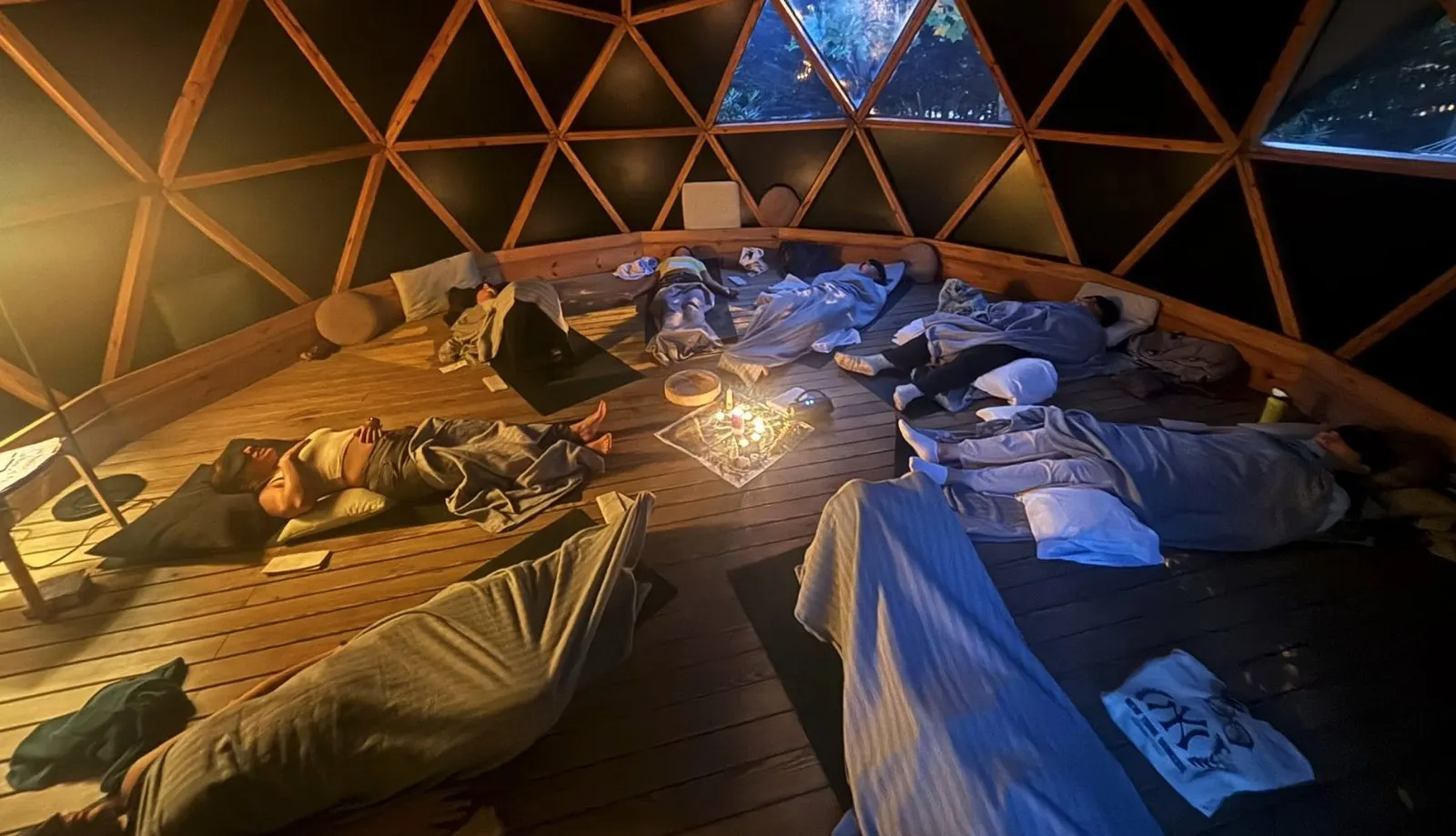
You lie down, usually for forty-five to sixty minutes of breathing, with a facilitator next to you. The instruction is simple and demanding: an active inhale, a released exhale, no pause between the two. The rhythm is faster and fuller than ordinary breathing, and it is sustained.
What people feel is fairly consistent: tingling in the hands and around the mouth, warmth, sometimes tetany, which is a cramping of the hands or face, and often emotion, including tears. None of that is mysterious. Breathing fast and full lowers the carbon dioxide in your blood, and that drop changes the acidity of the blood and the way calcium behaves at the nerve endings. It is the same mechanism behind the dizziness of a panic attack. It passes when the breathing slows.
A session ends with a long quiet phase, and that part matters as much as the breathing. What a serious facilitator does before any of it is ask about your health, and tell you how to stop.
Rebirthing breathwork and rebirthing therapy are not the same thing
This is the part the search results leave out. In April 2000, in Evergreen, Colorado, a ten-year-old girl named Candace Newmaker died of asphyxiation during a session of so-called rebirthing therapy: she had been wrapped in a blanket and pressed down by adults, to make her fight her way out and simulate birth. Two therapists were convicted of reckless child abuse resulting in death and sentenced to sixteen years in prison, and Colorado passed Candace's Law to prohibit that kind of restraint practice; North Carolina adopted its own, separate ban.
That practice came from attachment therapy. There is no breathing in it. It shares a name with rebirthing breathwork and nothing else. We say it plainly because the word is ambiguous and because the rule it gives you is useful: if anyone proposes to hold you down, wrap you up or restrict your breathing, you are not in a breathwork session, and you should leave.
What does the research actually say?
There is no controlled trial on rebirthing in particular. What exists covers breathwork as a family: a 2023 meta-analysis of randomised controlled trials found small to moderate improvements in stress, anxiety and depressive symptoms, and a systematic review of slow breathing describes measurable effects on the nervous system. Those findings are about breathing practices in general, not about this method, and it would be dishonest to borrow their authority for it.
Absence of specific evidence is not evidence that something does not work. It does mean nobody can promise you a result, and that a practice presented as a treatment for a medical or psychiatric condition is being misrepresented.
Who should avoid it, and when
Fast, sustained breathing with retentions is not a neutral activity. It is set aside, or only done with medical clearance, in pregnancy, epilepsy, uncontrolled cardiovascular conditions, glaucoma, recent surgery, and any history of psychosis or severe dissociation. If you take medication that affects the nervous system, ask the person who prescribed it.
We go through the whole picture, technique by technique, in our guide to whether breathwork is dangerous.
- Pregnancy: no fast breathing or retentions.
- Epilepsy or seizure history: medical advice first.
- Heart or blood-pressure conditions that are not stable: medical advice first.
- Glaucoma, recent surgery: avoid retentions.
- Psychosis, severe dissociation or acute crisis: see a clinician, not a facilitator.
Rebirthing, holotropic breathwork or active meditation: what is the difference?
They are often confused because all three use intense breathing. The differences are real, and they decide which one suits you.
- Rebirthing: connected circular breathing, one to one or in a small group, dry or in warm water, built around the birth narrative.
- Holotropic breathwork: developed by Stanislav Grof, long sessions in pairs, with loud music and a sitter.
- The Wim Hof method: rounds of fast breathing followed by breath retention and cold exposure.
- SUCO active meditation: breath, movement and live music, with no retention phase.
What we do at EMME
We do not run rebirthing sessions, and we would rather say so than stretch the word to fit what we offer. Our work is guided breathwork and SUCO active meditation with live music, near Barcelona in Gavà Mar, plus private sessions for couples and groups.
If you want several days of it rather than an hour, our retreat Back to You runs for seven nights in the Sahara, from 20 to 27 February 2027, with a group of twelve people at most.
Frequently asked questions
Is rebirthing dangerous?
The breathing practice carries the risks of any sustained fast breathing: dizziness, tetany, fainting, and real contraindications in pregnancy, epilepsy, unstable cardiovascular conditions and psychosis. The restraint practice that shares the name is a different matter: it has killed, and Colorado and North Carolina each prohibit it by law.
How long does a rebirthing session last?
Usually between one hour and ninety minutes in total, with forty-five to sixty minutes of breathing and a long quiet phase at the end.
Do you have to be in water?
No. Leonard Orr started in warm water, but almost all sessions today are dry, on a mat, with a blanket for warmth.
Does rebirthing recover memories of birth?
That is the hypothesis the name comes from, not a demonstrated fact. People do feel a great deal during a session; nothing shows that what they feel is a memory of their own birth.
Sources
- Fincham G. W., Strauss C., Montero-Marin J. & Cavanagh K. (2023). Effect of breathwork on stress and mental health: a meta-analysis of randomised-controlled trials. Scientific Reports, 13:432.
- Zaccaro A. et al. (2018). How breath-control can change your life: a systematic review on psycho-physiological correlates of slow breathing. Frontiers in Human Neuroscience, 12:353.
Rather live it than read about it?
Write to us on WhatsApp, +34 687 950 352: we tell you the next session in Gavà Mar, Castelldefels or Sitges.
Keep reading
Workplace wellbeing. What a session can change, and what it cannot.
Workplace wellbeing sorted honestly: what belongs to how work is organised, what a collective practice can actually change in an hour, and where the line sits.
Team building activities. What each one builds, and what it asks of your team.
Team building activities sorted by what they ask of a group: what each family builds, who it quietly excludes, and when more energy backfires on a team.
What is breathwork? Types, benefits and how to start.
What breathwork is, its main types (holotropic, rebirthing, Wim Hof, SOMA, pranayama), what science says about its benefits and how to start safely.
Holotropic breathwork: what it is, a session, the risks.
Created by Stanislav and Christina Grof, it combines fast breathing and evocative music. How a session works, its risks and gentler alternatives.
The Wim Hof method: breathing, benefits and contraindications.
How Wim Hof breathing is done step by step, what science says about its effects and who should not practise it, with the basic safety rules.
Breathing exercises for anxiety: five guided practices.
Five guided breathing exercises, each with a free timer, to calm anxiety within minutes and sleep better. What the science says, and when to ask for help.
What is a spiritual retreat? What really happens, hour by hour.
A spiritual retreat is a few days away from your routine, with a daily practice and a group. What a day really looks like, and who it does not suit.
How to choose a breathwork retreat. Seven questions, and the answers to expect.
Choosing a breathwork retreat: who facilitates, whether anyone screens you before booking, which techniques you will actually do, and how big the group is.
Ecstatic dance: what it is and how it differs from SUCO.
Ecstatic dance and SUCO both get you moving without steps to learn. One is free dance to a DJ set, the other a guided meditation in headphones. Which suits you?
How to choose a spiritual retreat near Barcelona.
Silent, yoga, breathwork or therapeutic: how to choose a spiritual retreat near Barcelona, which questions to ask the organiser and which red flags to avoid.
Is breathwork dangerous? Risks, precautions and benefits.
Slow breathwork is low risk for most people. Fast breathing and breath-holds are another story: what happens in the body, who should avoid it, how to stay safe.
Types of meditation: which one suits you, and where in Barcelona.
Seated, guided, active or breath-based: the main types of meditation for beginners, which one suits you, how to try it free and where in Barcelona.