
Is breathwork dangerous?
Risks, precautions and benefits.
For most people, slow and gentle breathwork is low risk. Fast, intense breathing and long breath-holds are different: they change the chemistry of your blood, can make you dizzy or faint, and are not for everyone. The risk depends on the technique, on your health and on the setting. The safest breathwork is the one chosen for you, guided by someone who asks the right questions first.
What happens in the body when you breathe fast?
When you breathe faster and deeper than your body needs, you blow off more carbon dioxide than usual. The level of CO2 in your blood drops, and that shift explains most of the strong sensations people describe: tingling in the hands, feet or around the mouth, lightheadedness, and sometimes hands that cramp and curl up on their own.
These sensations usually fade within minutes once breathing returns to normal. For a healthy person lying down, they are not dangerous in themselves, but they are a clear signal to slow down. A good facilitator watches for them and tells you what they are before the session begins.
Who should avoid intense breathwork?
Intense, fast or breath-holding techniques are not recommended without medical advice if you:
- are pregnant
- have cardiovascular disease or high blood pressure
- have severe asthma or another serious respiratory condition
- have epilepsy or a history of seizures
- have a severe psychiatric condition, or are in acute crisis
- have had recent surgery, or have an eye condition such as glaucoma or retinal detachment
When does breathwork become really dangerous?
Never practise breath-holds or fast breathing in water, in the bath, while driving, or anywhere a loss of consciousness could hurt you. Hyperventilating and then holding your breath for a long time can make you black out without warning. In water, that can be fatal.
The other real risk is emotional. Activating breathwork can bring up strong emotions or old memories. That is often the point, but if you carry trauma, go gently, tell the facilitator beforehand and make sure there is time and support for integration. Breathwork does not replace therapy.
How can you tell gentle from intense?
A rough map, with techniques you can try in our Breath Bank:
| Technique | Intensity | Precautions |
|---|---|---|
| Cardiac coherence, resonant breathing | Gentle | Suitable for most people |
| Physiological sigh, extended exhale | Gentle | Suitable for most people |
| Box breathing, 4-7-8 breathing | Gentle, with short holds | Shorten the holds if you feel uncomfortable |
| Kapalabhati, bhastrika | Activating | Seated, never in water; avoid if any condition above applies |
| Long sessions of fast or connected breathing | Intense | Only guided, after a health check |
What does research say about the benefits?
The evidence is strongest for slow breathing. A systematic review links slow-breathing practices to higher heart rate variability and to feeling calmer and more alert (Zaccaro et al., 2018). In a 2023 Stanford study, five minutes a day of cyclic sighing improved mood and reduced physiological arousal (Balban et al., 2023).
For breathwork more broadly, a 2023 meta-analysis of randomised controlled trials found it associated with lower self-reported stress than control conditions (Fincham et al., 2023). The authors also point to the limits of the current studies, so treat breathwork as a practice that helps, not as a treatment.
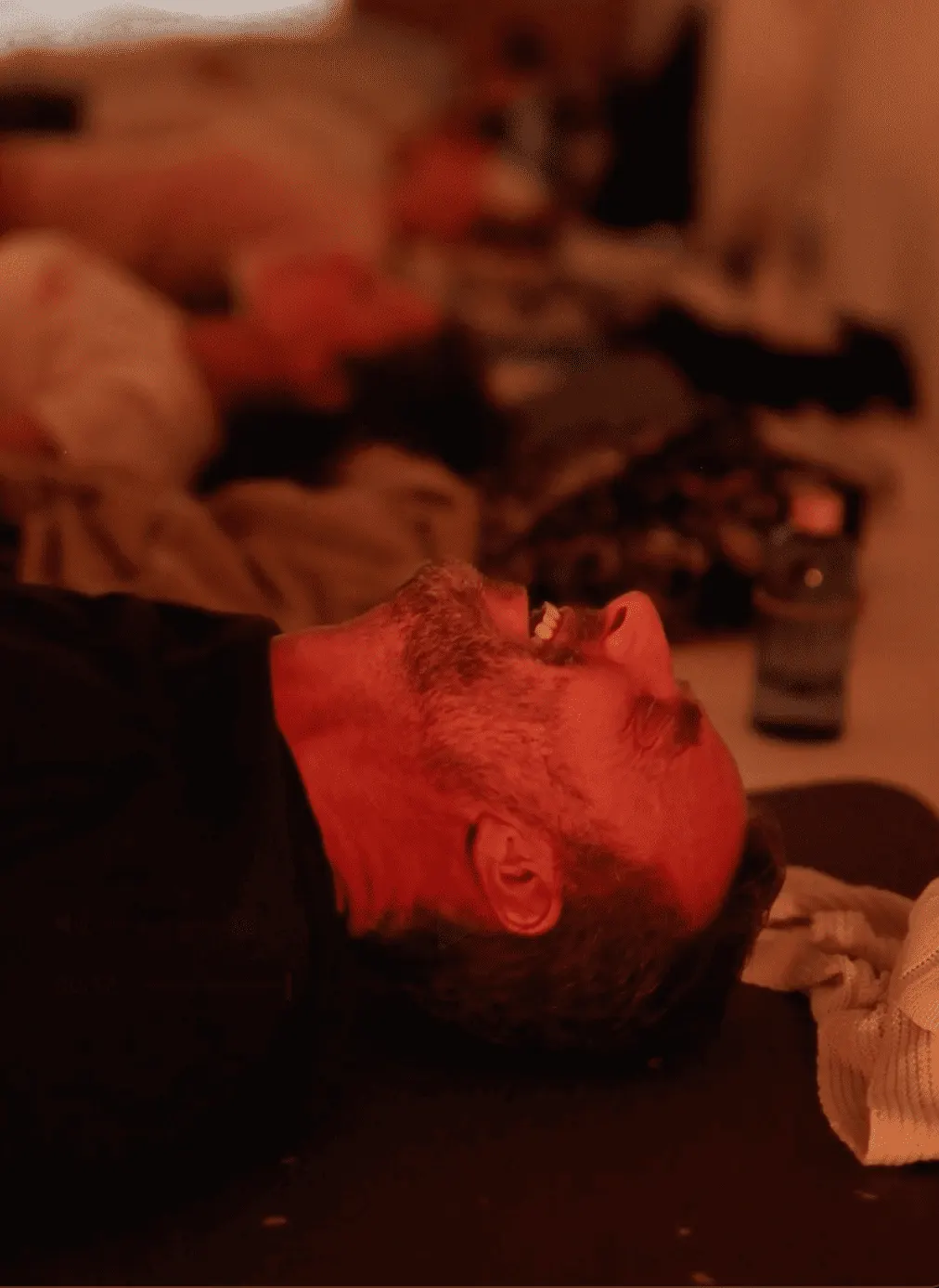
How does EMME keep breathwork safe?
We ask about your health when you book. We dose rather than force: depth begins with trust, not with pushing harder. You can slow down or stop at any moment, and every session keeps time for integration.
Read more about our method, join a guided session in Gavà Mar, or start with a gentle technique on your own in the Breath Bank.
Frequently asked questions
Is it normal for my hands to tingle during breathwork?
Yes, with fast breathing it is common. It comes from the drop of carbon dioxide in your blood. Slow your breath down and it usually passes within minutes; tell the facilitator if it worries you.
Is it normal to cry during breathwork?
Yes. Activating breathwork often releases emotions. Crying, laughing or shaking are common and they pass. You can always slow down.
Can breathwork trigger a panic attack?
Fast breathing can trigger panic-like sensations in some people, especially those prone to anxiety. Gentle techniques with a longer exhale are usually the better place to start.
Can I do breathwork while pregnant?
Avoid intense and breath-holding techniques, and ask your midwife or doctor before starting any breathing practice.
Sources
- Zaccaro A. et al. (2018). How breath-control can change your life: a systematic review on psycho-physiological correlates of slow breathing. Frontiers in Human Neuroscience, 12:353.
- Balban M. Y. et al. (2023). Brief structured respiration practices enhance mood and reduce physiological arousal. Cell Reports Medicine, 4(1):100895.
- Fincham G. W., Strauss C., Montero-Marin J. & Cavanagh K. (2023). Effect of breathwork on stress and mental health: a meta-analysis of randomised-controlled trials. Scientific Reports, 13:432.
Rather live it than read about it?
Write to us on WhatsApp, +34 687 950 352: we tell you the next session in Gavà Mar, Castelldefels or Sitges.
Keep reading
Workplace wellbeing. What a session can change, and what it cannot.
Workplace wellbeing sorted honestly: what belongs to how work is organised, what a collective practice can actually change in an hour, and where the line sits.
Team building activities. What each one builds, and what it asks of your team.
Team building activities sorted by what they ask of a group: what each family builds, who it quietly excludes, and when more energy backfires on a team.
What is rebirthing? Origins, a real session, and the cautions.
Rebirthing breathwork: where it comes from, what a session involves, why it is not the restraint practice of the same name, and who should avoid it.
What is breathwork? Types, benefits and how to start.
What breathwork is, its main types (holotropic, rebirthing, Wim Hof, SOMA, pranayama), what science says about its benefits and how to start safely.
Holotropic breathwork: what it is, a session, the risks.
Created by Stanislav and Christina Grof, it combines fast breathing and evocative music. How a session works, its risks and gentler alternatives.
The Wim Hof method: breathing, benefits and contraindications.
How Wim Hof breathing is done step by step, what science says about its effects and who should not practise it, with the basic safety rules.
Breathing exercises for anxiety: five guided practices.
Five guided breathing exercises, each with a free timer, to calm anxiety within minutes and sleep better. What the science says, and when to ask for help.
What is a spiritual retreat? What really happens, hour by hour.
A spiritual retreat is a few days away from your routine, with a daily practice and a group. What a day really looks like, and who it does not suit.
How to choose a breathwork retreat. Seven questions, and the answers to expect.
Choosing a breathwork retreat: who facilitates, whether anyone screens you before booking, which techniques you will actually do, and how big the group is.
Ecstatic dance: what it is and how it differs from SUCO.
Ecstatic dance and SUCO both get you moving without steps to learn. One is free dance to a DJ set, the other a guided meditation in headphones. Which suits you?
How to choose a spiritual retreat near Barcelona.
Silent, yoga, breathwork or therapeutic: how to choose a spiritual retreat near Barcelona, which questions to ask the organiser and which red flags to avoid.
Types of meditation: which one suits you, and where in Barcelona.
Seated, guided, active or breath-based: the main types of meditation for beginners, which one suits you, how to try it free and where in Barcelona.